

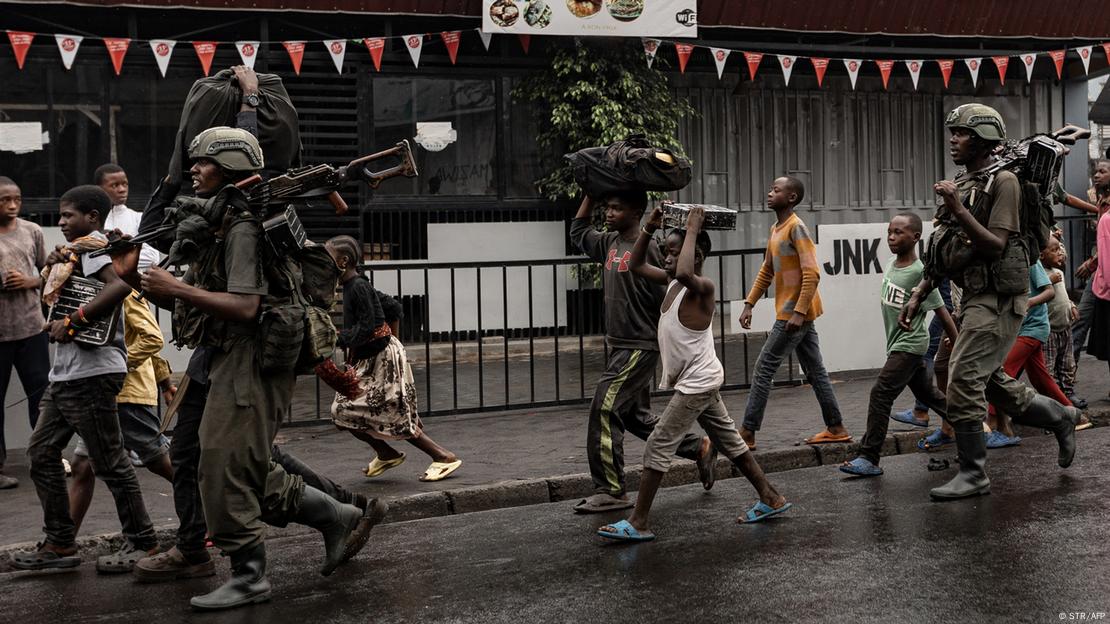
SURGING violence in the Democratic Republic of the Congo (DRC) has ignited fears of large-scale instability in one of Africa’s most conflict-ridden countries.
On 27 January, the M23 rebel group, backed by soldiers from neighbouring Rwanda, seized control of Goma, the largest city in eastern DRC.
Home to around one-million people, Goma plays an essential role in the country’s economy and administration.
Further adding to the chaos was a massive jailbreak at the city’s main prison that occurred on Monday.
It resulted in over 4 000 inmates escaping onto the streets and residents locking themselves indoors for safety.
Protestors also attacked the Belgian, Dutch, Kenyan, Ugandan and US embassies, demanding the international community pressure Rwanda over its alleged involvement.
DW explores the conflict’s complexities, including Rwanda’s controversial role in the DRC and the potential for broader regional unrest.
What is the conflict in eastern Congo?
The DRC has a wealth of natural resources, including metals and minerals such as gold, tin and coltan, essential for manufacturing mobile phones and batteries for electric vehicles.
The resources have sparked a cycle of corruption and bloodshed as armed groups, local militias and foreign actors vie for control of the territory.
The DRC has been rocked by conflict for more than 30 years since the 1994 Rwandan genocide.
The country’s citizens have been left to suffer the consequences.
Armed conflicts have internally displaced over seven-million people.
Human rights organisations have reported widespread atrocities, including massacres, sexual violence and the recruitment of child soldiers.
At the heart of the current crisis is the resurgence of the M23 rebel group led by ethnic Tutsi.
The armed group quickly gained power in 2012 and seized the city of Goma but was expelled by the Congolese army and UN forces in 2013.
M23 took up arms once again in 2021, claiming to protect the Tutsi population in eastern Congo from discrimination and violence.
However, DRC leaders in Kinshasa, the capital, say the group is merely a proxy for external forces striving to gain control of the country’s rich mineral resources, especially in territories bordering Rwanda and Uganda.
There are currently over 100 different armed groups seeking a foothold in the eastern DRC.
Efforts to pacify the region, including a peace deal between the DRC and M23 rebels signed in 2013 in Nairobi, have repeatedly failed.
What role does Rwanda play?
Rwanda’s involvement in the DRC is a point of international tension.
Rwandan leaders have repeatedly denied supporting the M23 rebels, but since 2012, UN experts and human rights organisations state explicitly that Rwanda supports M23 in the form of providing logistics, weapons and even personnel.
In part, this history has origins in the 1994 Rwandan genocide, during which 800 000 people, primarily from the Tutsi community, were slaughtered by ethnic Hutu extremists.
The genocide ended with Rwanda’s current president, Paul Kagame, leading a force of Tutsi rebels.
Many Hutu then fled across the border to the DRC.
Kagame has called for the need to neutralise the Democratic Forces for the Liberation of Rwanda (FDLR), a Hutu rebel group operating in eastern DRC.
His government claims some members of this group who participated in the 1994 genocide pose a direct threat to Rwanda’s security.
However, the DRC government accuses Rwanda of using the conflict as a cover for exploiting its natural resources, particularly in areas controlled by M23.
Mineral trade, including the illegal trafficking of gold and coltan, is a lucrative business that allegedly benefits Rwanda while destabilising the DRC.
Dr. Hassan Khannenje, the Director of the HORN International Institute for Strategic Studies, told DW that Rwanda is unlikely to leave the DRC in peace anytime soon.
“Rwanda has, is, and will always be involved in the DRC. The country is of strategic and national interest to Rwanda, so it’s not only about the minerals,” he said.
“However, the minerals tend to fuel the fire,” he added.
Khannenje said competing rebel groups give additional “rationale to occupy parts of DRC”.
The diplomatic fallout has been severe.
On 26 January, the DRC severed diplomatic ties with Rwanda.
Regional efforts to mediate have yielded little progress.
Could the conflict escalate?
According to the UN, the conflict in the DRC can potentially escalate into a broader regional crisis.
However, some experts, including Khannenje, say it is unlikely.
“What we may see is perhaps just an escalation of the fighting parties — that’s the government (of the DRC) as well as M23 — and some increased support either from countries in the region or from outside of it,” Khannenje said.
Uganda, like Rwanda, has also been accused of backing armed groups in eastern Congo, though it denies these claims.
Meanwhile, refugees from North Kivu in eastern DRC are already fleeing to neighbouring countries, heightening fears of cross-border instability.
Sanctions have been imposed on M23 leaders, and there have been warnings against foreign interference.
However, the global response remains muted, leaving African nations to bear the brunt of the conflict’s consequences.
The stakes are dire for the DRC’s population of over 100-million people.
Humanitarian organisations warn that the violence could lead to famine, outbreak of disease, and further mass displacement.
Without urgent action, the conflict risks spiralling into a large-scale tragedy with consequences for the entire region. – DW